Binance Review 2026:
Is It Safe, What Does It Cost, and Who Is It For?
Security, Proof of Reserves, fees, sign-up, KYC, withdrawals and how Binance compares with Coinbase, Kraken and OKX, based on the official pages we checked on October 20, 2026.
Updated October 20, 2026 · By the xtexe.com editorial team · We use referral links; see how we review below.
Independent review site, not Binance. This button opens binance.com in a new tab and may contain an affiliate referral parameter.
Binance in October 2026, in six points
- Fees: regular users pay 0.100% maker / 0.100% taker on spot trades, or 0.075% when paying fees in BNB, per the official fee schedule.
- Reserves: the Proof of Reserves snapshot dated October 1, 2026 shows 100.35% BTC, 100.00% ETH and 103.88% USDT reserve ratios. Useful, but not a full audit.
- Track record: in 2023 Binance pleaded guilty to US charges and agreed to pay about $4.3 billion. It now runs under stricter compliance obligations.
- Availability: Binance.com does not serve US residents (Binance.US is a separate platform). Elsewhere, access depends on local rules.
- Best for: cost-conscious, self-directed traders who want many coins and deep order books. Less suited to beginners who want hand-holding.
- Rule of thumb: an exchange is for trading, not long-term storage.
Is Binance safe to use in 2026?
Binance offers strong account-security tools and publishes regular Proof of Reserves, but it is still a custodial exchange with a serious regulatory history, so "safe" means "reasonably well protected if you set it up properly", never "guaranteed". While your coins sit on Binance, Binance controls the private keys and you rely on its solvency and security.
What security features does Binance offer?
Most account takeovers come from weak logins or phishing, not exchange hacks. Several of these tools are optional, so switch them on before you deposit.
- Two-factor authentication (2FA) and passkeys: protect logins and withdrawals with an authenticator app, a passkey or a security key. These are stronger than SMS codes, which SIM-swap attacks can intercept.
- Anti-phishing code: a phrase you choose that appears in genuine Binance emails. An email without it is a red flag.
- Withdrawal whitelist (address management): when enabled, withdrawals can only go to addresses you saved in advance, so an intruder cannot simply send funds elsewhere.
- Device management and withdrawal holds: review active devices and logins; after sensitive changes such as a password or 2FA reset, Binance may temporarily restrict withdrawals.
What is the Binance SAFU fund, and does it protect you?
SAFU (Secure Asset Fund for Users) is an emergency reserve Binance created in 2018 for extreme cases such as a security breach. On the sign-up page we viewed on October 20, 2026, Binance states the fund holds 1,000,000,000 USDC and lists a public wallet address you can check on-chain. It is not insurance or a government protection scheme: Binance decides if and how it is used, and it does not cover your own mistakes, such as sending coins on the wrong network or falling for a scam.
What does Binance Proof of Reserves actually prove?
Proof of Reserves (PoR) shows whether Binance's wallets held at least as much of each listed asset as customers' net balances at one moment. The page we checked showed an audit time of 01/10/26 00:00:00 UTC (October 1, 2026), zk-SNARKs as the verification mechanism and a published Merkle root hash.
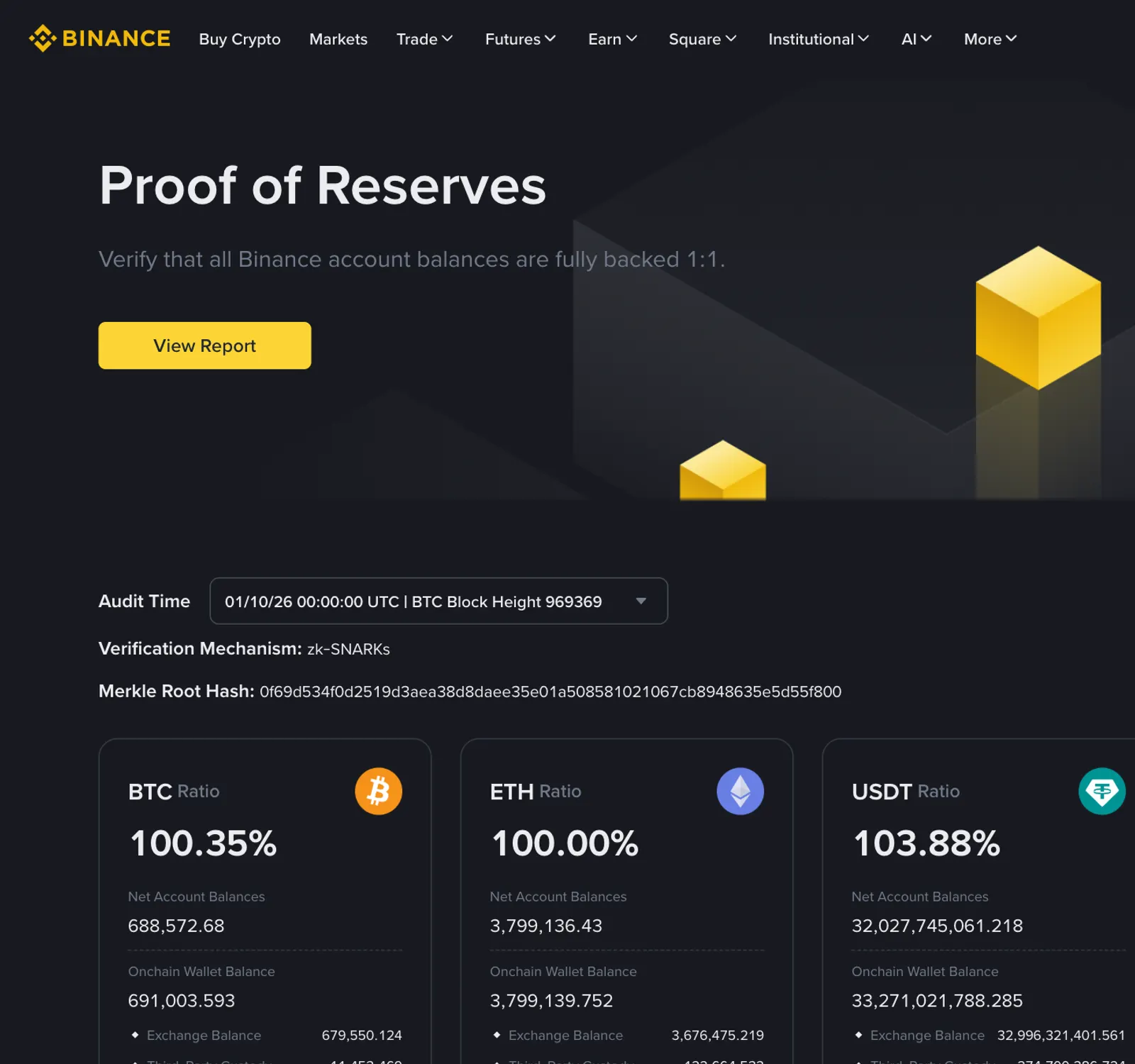
The ratios were 100.35% for BTC, 100.00% for ETH and 103.88% for USDT; 100% or more means reserves covered customer balances for that asset on the snapshot date. The zk-SNARK proof shows the totals add up without revealing individual balances, and logged-in users can check their own balance was included. The limits: it is a point-in-time snapshot, and it is not a full audit of Binance's company finances or liabilities. See the latest figures on the official Proof of Reserves page.
What changed after Binance's 2023 US settlement?
In November 2023, Binance pleaded guilty in the US to charges including failing to maintain an effective anti-money-laundering program, unlicensed money transmission and sanctions violations. With the related CFTC and US Treasury resolutions, penalties totalled about $4.3 billion. Founder Changpeng Zhao stepped down as CEO and pleaded guilty to a separate charge; Richard Teng became CEO, and Binance came under independent compliance monitoring. You can read the primary documents from the US Department of Justice and the CFTC.
For users, the result is a stricter platform: KYC is mandatory, transactions are monitored more closely, and you may be asked where funds came from. Later events, including the dismissal of a separate SEC lawsuit in 2025 and a US presidential pardon for Zhao in October 2025, do not undo the guilty plea; the regulatory picture keeps changing, so re-check the news before committing large sums.
How do you spot fake Binance websites, apps and "support" agents?
Use Binance Verify, the official checker, to confirm whether a website, email, phone number, Telegram or social account really belongs to Binance.
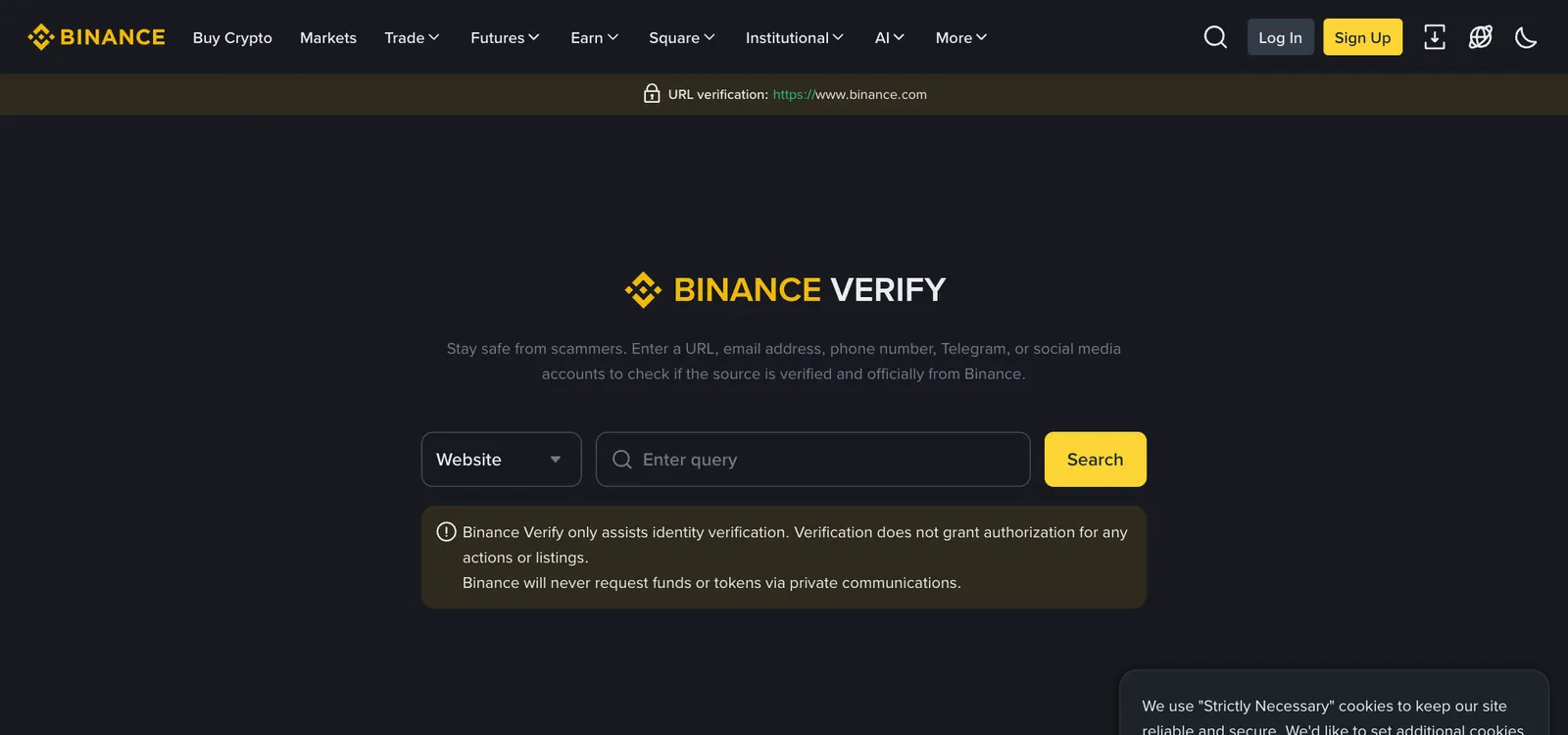
The page itself warns that Binance will never request funds or tokens through private communications. Keep these habits:
- Type binance.com yourself or use a bookmark; look-alike domains and search ads are a common trap.
- Never share 2FA codes or screen recordings, even with people claiming to be Binance staff.
- Ignore unsolicited messages about "frozen accounts" or "guaranteed" returns, and check contacts on the official Binance Verify page.
- Trading P2P? Learn the common chargeback scams in our P2P safety guide.
If you plan to hold coins for months or years, move them to a wallet you control; our hardware wallet guide explains how.
Can I use Binance in the US, the UK or my country?
It depends on where you legally live: Binance.com does not accept US residents, people in the US are directed to the separately operated Binance.US, and access elsewhere depends on local rules that can change quickly. Check the official site and terms for your country first.
Binance vs Binance.US: what is the difference?
Binance.com and Binance.US share a brand but are separate platforms with separate accounts, terms, fees, coin lists and funding methods; an account on one does not work on the other. Binance.US serves US residents, generally offers fewer coins and products, and its availability can differ by state, so check its own eligibility information. If you are a US resident, Binance.com is not an option, and you should not try to get around that restriction.
Is Binance available in the UK?
The UK situation changed in 2023, when new rules on crypto financial promotions took effect and Binance announced it would stop onboarding new UK users. Whether you can open an account today depends on Binance's current terms and UK rules, so check the official site and the FCA register yourself, and do not assume FCA protection.
How do I check whether Binance is allowed in my country?
- Read the restricted-locations section of the official Binance Terms of Use; the list is updated over time.
- Check which local Binance entity would serve you; it determines which rules apply.
- In the EU, MiCA requires crypto providers to be authorised; check the register published by ESMA or your national regulator.
- Watch the official Binance announcements page for changes to products or payment methods in your region.
Using Binance from a location it does not serve breaches its terms and can lead to a frozen account. If it is not available where you live, choose a platform that is.
How much are Binance fees in 2026?
For a regular user, Binance's spot trading fee is 0.100% for makers and 0.100% for takers, falling to 0.075% if you choose to pay fees in BNB, according to the official fee schedule we checked on October 20, 2026. A maker order adds liquidity (a limit order that rests on the book); a taker order removes it (a market order).
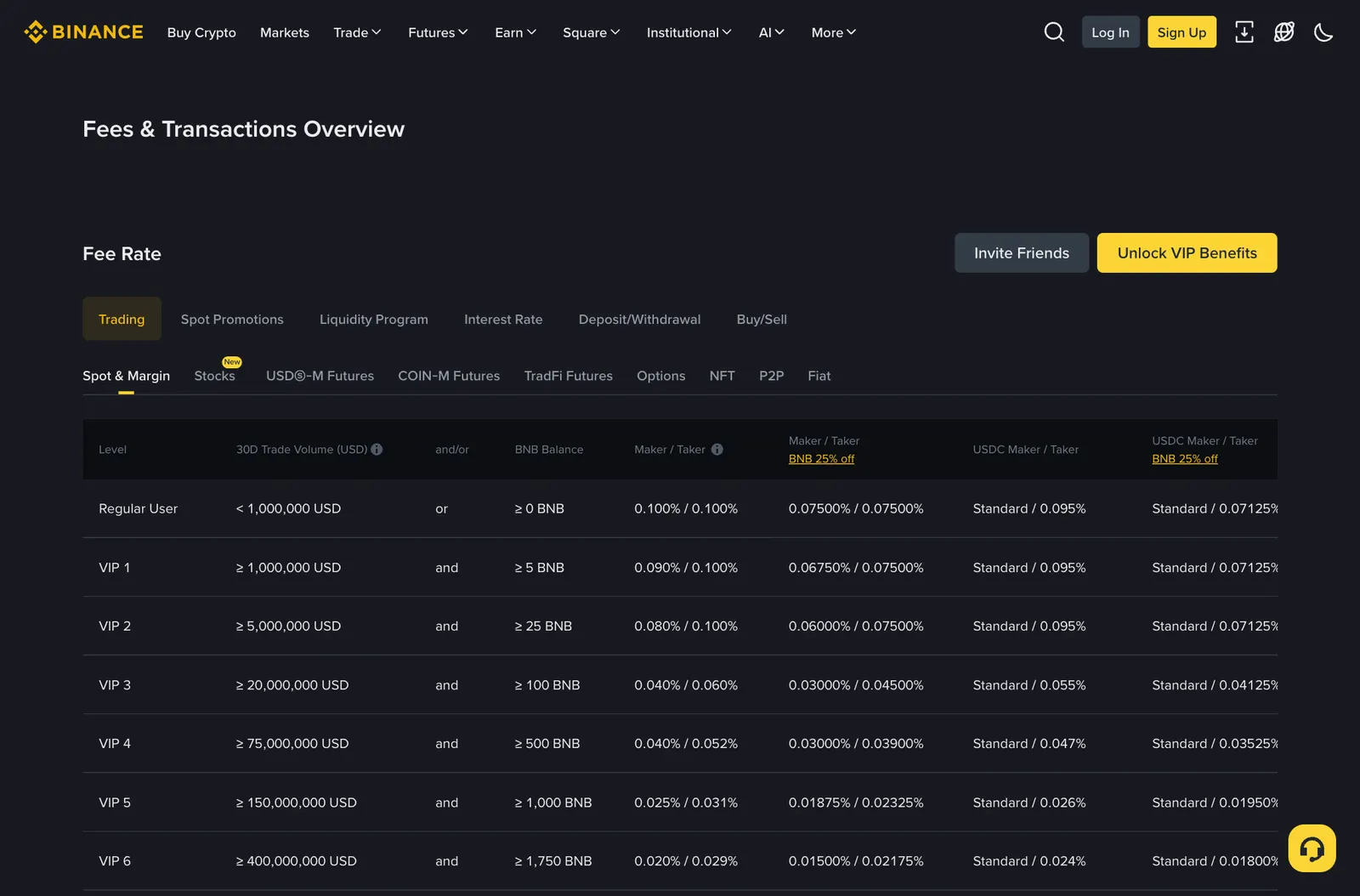
VIP rates start at a 30-day volume of 1,000,000 USD, so most individuals pay the regular rate. Confirm current rates on the official Binance fee schedule.
How much does a $1,000 trade cost on Binance?
At the regular rate, a $1,000 spot trade costs $1.00 in fees, or $0.75 with BNB. Buying and later selling counts as two trades, so a round trip costs roughly double.
| Trade size | Standard fee (0.100%) | Paying with BNB (0.075%) | Round trip, standard (buy + sell) |
|---|---|---|---|
| $100 | $0.10 | $0.075 | about $0.20 |
| $1,000 | $1.00 | $0.75 | about $2.00 |
| $10,000 | $10.00 | $7.50 | about $20.00 |
These are trading fees only, excluding spread, slippage and payment costs. Holding BNB for the discount also exposes you to BNB's price swings.
What about futures, withdrawal and deposit fees?
- Futures: USDⓈ-M and COIN-M futures have their own fee tables, plus periodic funding payments. Futures are leveraged and not available everywhere; read our spot vs futures guide first.
- Crypto withdrawals: the fee depends on the coin and network and changes over time; Binance shows it before you confirm.
- Crypto deposits: you pay the sending side's network fee; check the deposit page for any Binance-side charges.
- Fiat: card, bank transfer and fiat withdrawal charges vary by country, currency and payment partner.
Where do the hidden costs on Binance come from?
Common extras are the spread built into instant "Buy Crypto" and "Convert" quotes, card charges, P2P prices set by advertisers, and slippage on large market orders in thin markets. For the lowest cost, place a limit order on a liquid pair such as BTC/USDT instead of using one-tap buy screens.
Is Binance good for beginners?
Binance is workable for beginners who stick to the simple buy, convert and spot screens, but the full trading interface is dense and puts margin, grid bots and futures only a click away.
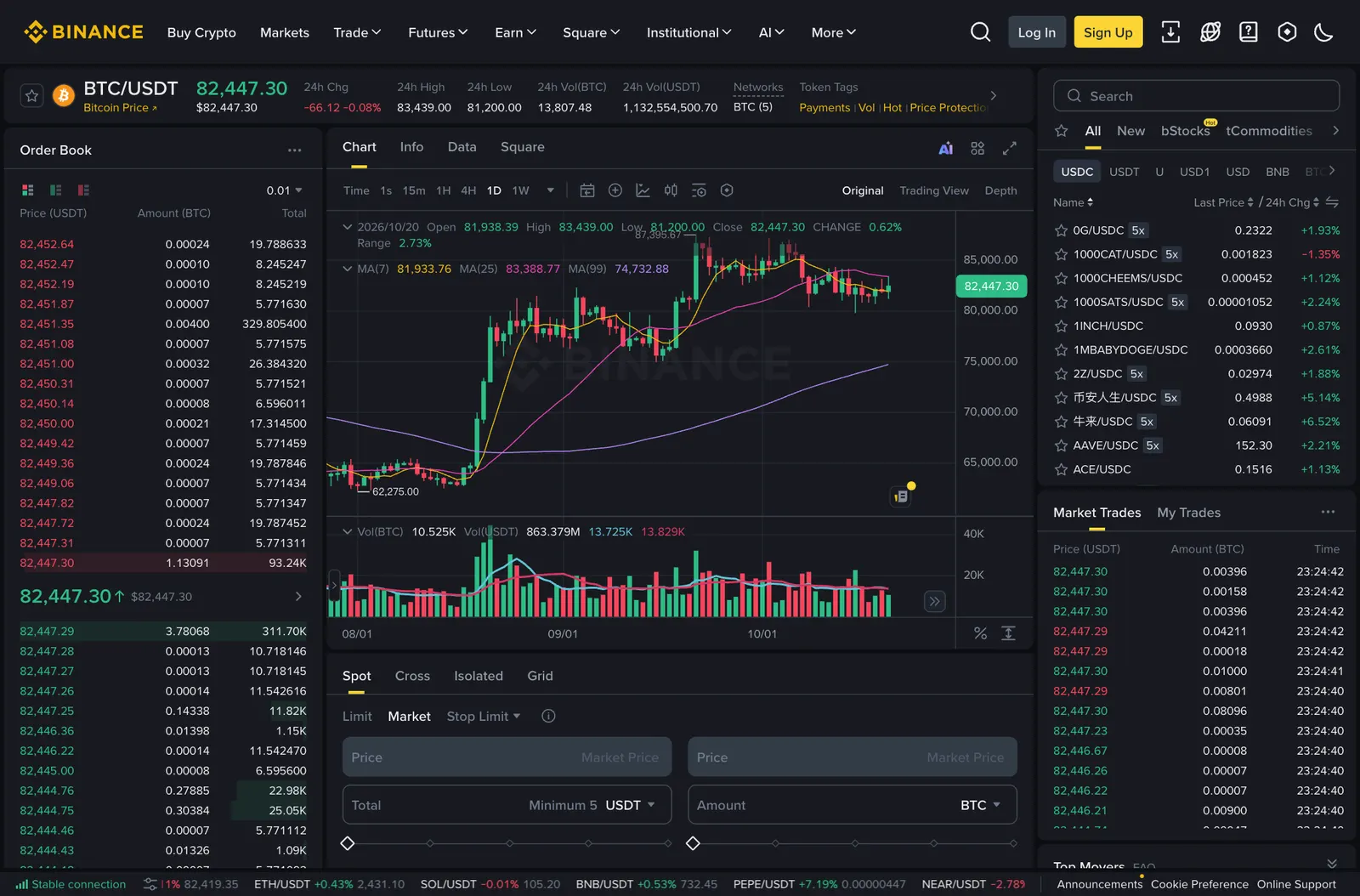
The order form offers Limit, Market and Stop Limit orders. The "Cross", "Isolated" and "Grid" tabs next to "Spot" are margin and bot modes; beginners should stay on Spot, where you cannot lose borrowed money. When we checked, the minimum market order on this pair was 5 USDT. The mobile app also has a simpler mode that hides most advanced tools.
How do I sign up for Binance, and where does the referral ID go?
You can open a Binance account in a few minutes: the current web sign-up page asks only for an email address or phone number on the first screen, or lets you continue with Google, Apple or Telegram, and identity verification comes afterwards.
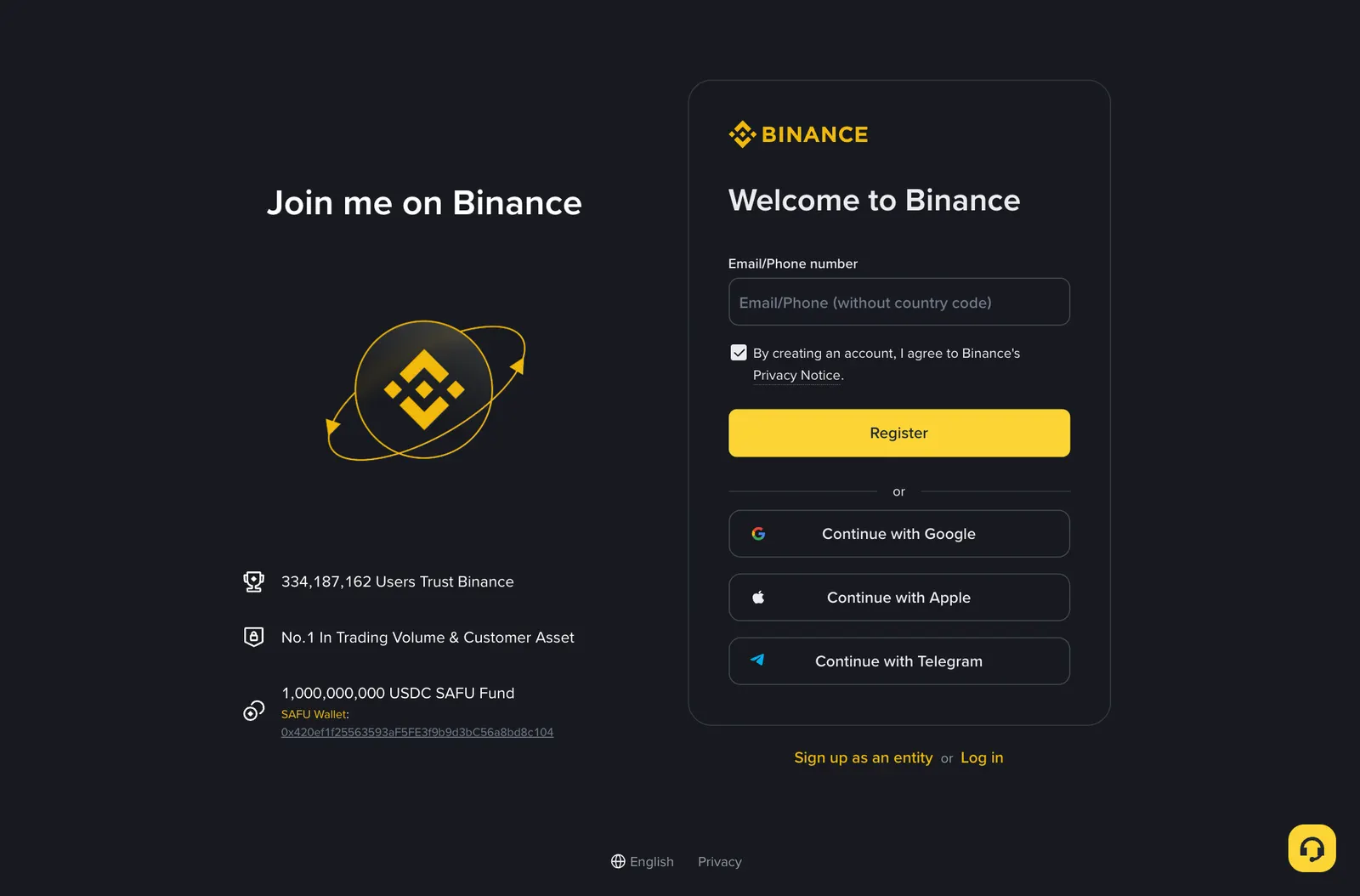
- Step 1, open the official site: go to binance.com or use the button on this page, and check the domain.
- Step 2, enter your email or phone number: accept the Privacy Notice and select Register, or use Google, Apple or Telegram.
- Step 3, confirm the code: enter the verification code Binance sends and follow the prompts.
- Step 4, turn on security: add an authenticator app or passkey, set an anti-phishing code and consider the withdrawal whitelist.
- Step 5, verify your identity: complete KYC before you deposit.
Where do I enter a Binance referral ID?
If you open Binance through our link, the referral is applied automatically and you do not need to type anything. If you register another way, the sign-up flow may show an optional referral ID field; our referral ID is BN6691. In general, a referral cannot be added after the account is created. We receive a commission for these sign-ups; it does not change your fees or this review.
What do you need for Binance KYC verification?
Binance identity verification (KYC) usually asks for your basic personal details, a government-issued photo ID and a live face scan; some users are also asked for proof of address or for information about the source of their funds.
Which documents does Binance accept?
Options depend on your country but typically include a passport, national ID card or driving licence. Use a valid original that matches the details you entered; photocopies and screenshots are usually rejected.
How long does Binance verification take?
Many applications are processed quickly, but there is no guaranteed time; manual reviews and extra document requests take longer. Finish KYC before you need to trade.
Why does Binance reject KYC, and how do you fix it?
- Poor image quality: blur, glare, shadows or cropped corners. Use good light and keep all four edges visible.
- Mismatched details: the name, date of birth or nationality you typed does not match the document exactly.
- Wrong or expired document: the document type is not accepted for your country, or it has expired.
- Face scan failures: poor lighting, glasses, hats or moving too fast during the liveness check.
- Eligibility issues: you are under 18, or your country of residence is one Binance does not serve.
If rejected, fix the stated issue and resubmit, or contact support inside the official app. Never send ID documents to a "support agent" over Telegram, WhatsApp or email.
How do deposits and withdrawals work on Binance?
You can fund Binance by sending crypto from another wallet or, depending on your country, with a bank card, a bank transfer or a P2P trade; withdrawals work in reverse, and the methods you see depend on your country, currency and verification level.
Which fiat payment methods can I use on Binance?
- Bank card: the fastest way to buy via "Buy Crypto" where supported, and usually the most expensive.
- Bank transfer: where local rails are supported (for example SEPA in some countries), usually cheaper but slower than cards. Banking partners change, so check the deposit screen.
- P2P marketplace: you trade with other users while Binance holds the seller's crypto in escrow. Never release crypto until the money has actually arrived in your bank account; see our P2P safety guide.
How do I withdraw USDT safely: TRC20, ERC20 or BEP20?
Choose a network that the receiving wallet or exchange explicitly supports for USDT, and pick the same network on both sides. USDT exists on several blockchains: TRC20 runs on Tron, ERC20 on Ethereum and BEP20 on BNB Smart Chain. Fees and speeds differ. Do not rely on the address format: ERC20 and BEP20 addresses both start with "0x", so an address can look valid on the wrong network, and funds sent there may be impossible to recover. Copy the address from the recipient's deposit page and confirm the network name before you submit.
When do I need a memo or tag?
Some assets, such as XRP (destination tag) and XLM (memo), use a second identifier so the receiving exchange knows which account to credit. If the recipient's deposit page shows a memo or tag, you must enter it, or the deposit may need manual recovery or be lost.
Why should you send a small test amount first?
A test costs one extra network fee and can save your whole balance: whitelist the address, send a small amount, wait until it arrives, then send the rest. If a withdrawal is stuck, check the announcements page for network maintenance. For storing coins off the exchange, see our cold wallet guide.
Binance vs Coinbase vs Kraken vs OKX: which exchange is better?
No exchange wins on everything: Binance and OKX offer the broadest range of coins and products, Coinbase is the simplest and most established option for US users, and Kraken sits between them with a long operating history and availability in the US and Europe. The table is qualitative on purpose: fees change often, so we link to each official fee page instead of quoting numbers.
| Feature | Binance.com | Coinbase | Kraken | OKX |
|---|---|---|---|---|
| US residents | Not accepted (Binance.US is separate) | Yes, US-based | Yes, with state-level limits | Separate US offering; check eligibility |
| Coin selection | Very wide | Moderate | Moderate | Wide |
| Derivatives | Extensive, region-dependent | Limited, region-dependent | Available in eligible regions | Extensive, region-dependent |
| Beginner experience | Dense interface; simple mode in app | Simplest | Moderate | Dense interface |
| Reserve transparency | Regular Proof of Reserves (zk-SNARKs) | Publicly listed company with audited financial statements | Periodic Proof of Reserves | Regular Proof of Reserves |
| Official fee page | Binance fees | Coinbase fees | Kraken fees | OKX fees |
In short: if you live in the US, the realistic shortlist is Coinbase, Kraken or Binance.US. If you live in a country Binance serves and you trade often, Binance's low standard spot fee and deep order books are hard to beat, and OKX is the closest like-for-like alternative; see our OKX review. If simplicity matters more than cost, Coinbase is easier to learn.
Who should use Binance, and who should not?
Binance suits people who manage their own security and want low fees and a wide market; it suits those who want hand-holding less well.
A good fit if you…
- Trade regularly: a 0.100% standard spot fee (0.075% with BNB) keeps costs low for frequent trades.
- Want breadth: you want many coins and trading pairs, with deep order books on major pairs.
- Use P2P: you live where local bank rails are limited and you understand P2P risks.
- Value transparency: you will actually check Proof of Reserves and use whitelisting and 2FA.
Probably not for you if you…
- Live in the US: Binance.com does not serve US residents; look at Binance.US or US-based exchanges.
- Want the simplest app: the full interface is busy, and leveraged products are close at hand.
- Need local protection: you want a platform clearly authorised by your own regulator with a clear complaints process.
- Plan to store long-term: large, long-term holdings belong in self-custody, not on any exchange.
Is Binance worth it in 2026? Our verdict
For self-directed traders in countries where it is permitted, Binance remains one of the strongest low-cost choices, with a 0.100% standard spot fee, deep markets and better-than-average reserve transparency. For US residents, nervous beginners and anyone who puts regulatory protection ahead of cost, another platform will usually be a better fit.
The positives are checkable: the fee schedule, reserve ratios at or above 100% for BTC, ETH and USDT, and mature security tools. The negatives are real too: a 2023 US guilty plea, country-by-country availability and an interface that makes risky products easy to reach. We do not give a star score, because one number would hide the trade-offs that decide whether Binance suits you. Check the official pages for your country and start small.
How do we review crypto exchanges?
We review exchanges by checking their official pages directly, comparing what they publish with regulatory records, and explaining trade-offs rather than ranking platforms by commission.
- What we checked for this update: on October 20, 2026, we checked Binance's official fee schedule, Proof of Reserves page, web sign-up page, Binance Verify and the BTC/USDT spot screen, logged out, and took the screenshots shown here.
- What we did not do: for this update we did not make deposits, trades or withdrawals with real money, and we did not test account-only features or customer-support response times. For those features we rely on Binance's public documentation.
- Regulatory history: we use primary sources such as US Department of Justice and CFTC releases, not secondary summaries.
- Referral links: we may earn a commission if you sign up through our links. Binance does not review or approve our content.
- Corrections and updates: we re-check key facts at each update; report errors via our legal page.
Binance FAQ: quick answers to common questions
Can I use Binance without KYC?
No, not in any meaningful way. Binance requires identity verification before you can use core features such as deposits, trading and withdrawals. Avoid anyone selling "no-KYC" or pre-verified accounts; using someone else's account breaches Binance's terms.
What happens if I lose my phone or authenticator app?
You can request a security reset through the official Binance app or website, which usually involves verifying your identity again. Withdrawals may be temporarily restricted afterwards as a safety measure. Store your authenticator backup key offline to avoid this.
Do I need to hold BNB to trade on Binance?
No. BNB is optional. If you enable paying fees with BNB and hold some, the regular spot fee drops from 0.100% to 0.075%. Without BNB, fees are simply deducted from the asset you trade.
How long do Binance withdrawals take?
Crypto withdrawals depend on Binance's internal checks and on how many network confirmations the receiving side requires, so times vary by coin and network. Fiat withdrawals depend on the payment method and your bank. Maintenance, security holds or compliance reviews can add delays.
Is Binance Earn risk-free?
No. Earn products are not bank deposits and are not covered by deposit insurance. Rates are variable and not guaranteed, some products lock your funds for a set period, and you still carry the price risk of the coin you deposit.
Can Binance freeze or restrict my account?
Yes. Like any regulated financial service, Binance can restrict accounts for security reviews, compliance checks, legal requests or breaches of its terms. If it happens, respond only through the official app or website and keep records.
Do I have to pay tax on crypto bought on Binance?
Possibly. Tax rules depend on your country, and many countries treat selling, swapping or spending crypto as a taxable event. You can export your transaction history from your account; ask a local tax professional for advice.
Where can I check these Binance facts myself?
Key figures come from official pages; values may change after October 20, 2026.
- Binance fee schedule: spot, futures, deposit/withdrawal and fiat fees.
- Binance Proof of Reserves: reserve ratios and the user inclusion check.
- Binance Verify: check whether a website, email or social account is official.
- Binance Terms of Use: eligibility and restricted locations.
- Binance announcements: product, network and regional changes.
- US Department of Justice and CFTC: the 2023 resolutions.